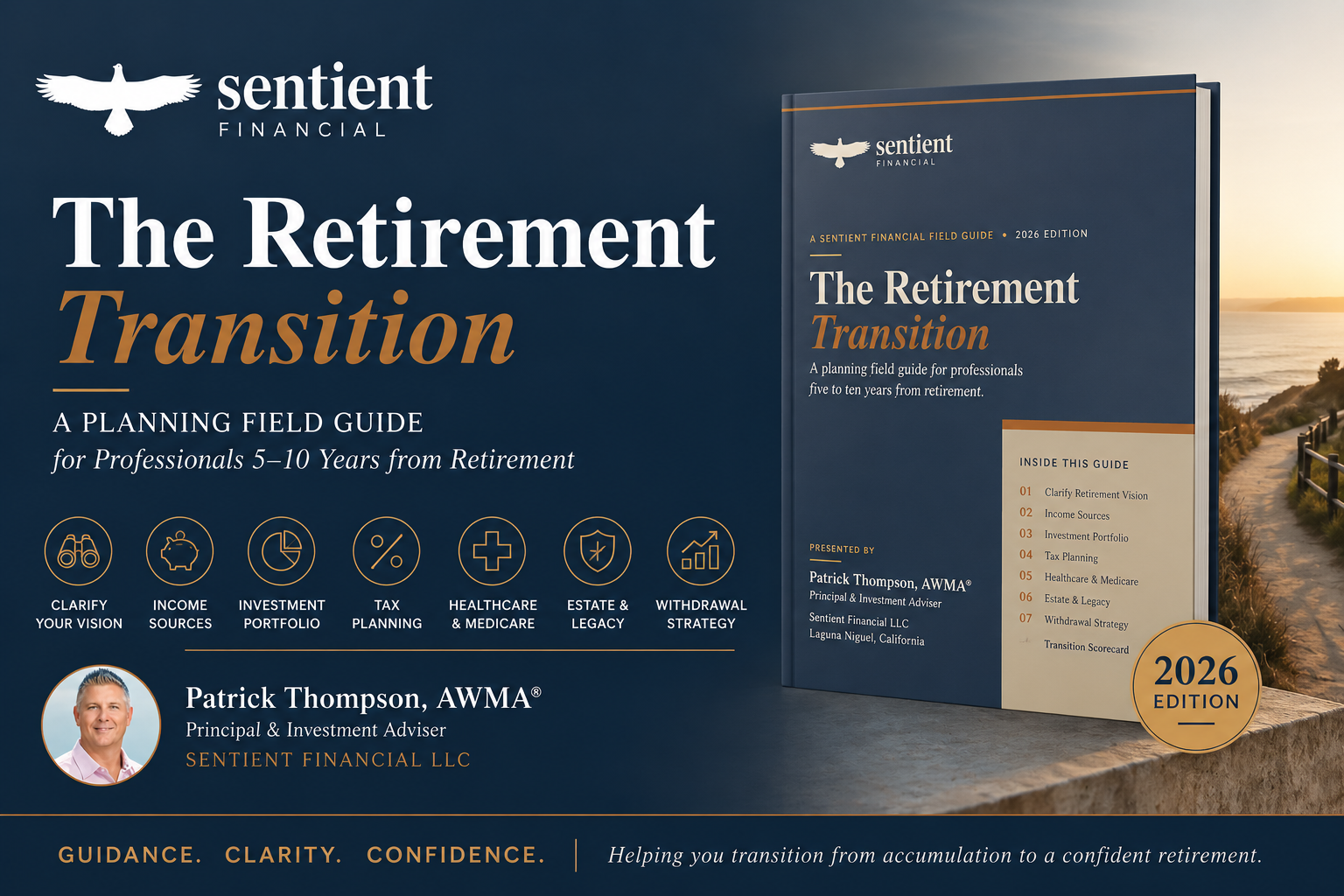
Retirement Transition Field Guide

The 5–10 Years Before Retirement Are Where Most Mistakes Happen

Not because people aren’t saving—but because they haven’t structured how it turns into income.

Saving consistently.
Investing for growth.
Letting time and discipline do their work.

Now, as retirement gets closer, the questions begin to change.

Not just how much you’ve accumulated—
but how it actually turns into income.

How it’s taxed.
How it holds up over time.

This guide is designed to help you think through that transition in a more structured way. If you’d like a version you can keep, download it hear.

Your Portfolio Has a New Job

For most of your career, your financial strategy had one objective: accumulate assets.

You contributed to retirement accounts, invested for growth, and allowed compounding to work in your favor.

As retirement approaches, that role begins to shift.

Your portfolio is no longer just a growth engine.
It becomes the source of your income.

And that transition—more than anything else—is where planning becomes more nuanced.

Clarify Your Retirement Vision

Before getting into numbers or strategies, it’s worth stepping back and defining what retirement actually looks like for you.

  • Identify your intended retirement age

  • Estimate baseline spending needs

  • Estimate lifestyle spending

  • Consider where you plan to live in retirement

  • Discuss expectations with your spouse or partner

Guide Insight:
Retirement planning begins with clarity around the life your assets must support.

Understand Your Future Income Sources

Retirement income rarely comes from one place. It’s typically a combination of sources working together.

  • Review Social Security benefit estimates

  • Evaluate possible claiming strategies

  • Confirm pension benefits if applicable

  • Identify rental or passive income streams

  • Estimate the income gap your portfolio must fill

Guide Insight:

Retirement income planning focuses on constructing a dependable paycheck from multiple sources. Get the guide

Prepare Your Investment Portfolio

A portfolio built for accumulation often needs adjustment as retirement approaches.

  • Review asset allocation and risk exposure

  • Evaluate how the portfolio supports withdrawals

  • Identify concentration risk

  • Review diversification across asset classes

  • Confirm alignment with your retirement timeline

Guide Insight:
A portfolio designed for accumulation often requires adjustment as retirement approaches.

Evaluate Tax Planning Opportunities

Taxes don’t stop in retirement—in many ways, they become more important.

  • Review projected tax brackets

  • Consider Roth conversion strategies

  • Coordinate withdrawals between taxable, IRA, and Roth accounts

  • Evaluate capital gains exposure

  • Review charitable planning opportunities

Guide Insight:
Tax planning can significantly influence how long retirement assets last.

Plan for Healthcare and Medicare

Healthcare is often one of the largest and least predictable retirement expenses.

  • Estimate retirement healthcare costs

  • Understand Medicare enrollment timing

  • Evaluate supplemental insurance options

  • Consider long-term care planning strategies

Guide Insight:
Healthcare often becomes one of the largest retirement expenses.

Review Estate and Legacy Planning

As retirement approaches, it’s important to ensure everything is structured the way you intend.

  • Confirm beneficiary designations

  • Review wills and trusts

  • Confirm powers of attorney

  • Review healthcare directives

  • Discuss legacy intentions with family

Guide Insight:
Estate planning ensures assets transfer efficiently and according to your wishes.

Design Your Retirement Withdrawal Strategy

How you draw from your portfolio often matters as much as how it’s invested.

  • Estimate sustainable withdrawal rates

  • Determine withdrawal sequencing

  • Understand required minimum distribution rules

  • Stress-test the plan against market volatility

Guide Insight:
Retirement outcomes are often shaped by withdrawal strategy more than investment returns.
Get the guide

Retirement Transition Scorecard

As you read through this guide, you can use it as a simple checklist.

Count the number of items you’ve addressed across each section.

Score Interpretation:

  • 0–10 → Early planning stage. Several areas may need attention

  • 11–20 → Good progress. Your retirement framework is forming

  • 21–30 → Well positioned. Many key planning elements are aligned

31+ → Strong alignment across major retirement planning decisions

Understanding Your Results

This scorecard is intended as a reflection tool—not a prediction of retirement success.

For many professionals, the five to ten years leading up to retirement is when the most meaningful decisions take place—particularly around income, taxes, and portfolio structure.

If reviewing this guide raises questions about your own transition, that’s typically a sign you’re at the stage where more structured planning can be helpful.

A Simple Next Step

If you’re within a few years of retirement, this is typically the stage where the questions become more specific—how this applies to your situation, your accounts, your timing.

If you’d like a second set of eyes on that, I offer a short introductory conversation.

Schedule a 20-Minute Retirement Fit Call

A focused conversation to review where you are today—and whether working together may make sense.

About Sentient Financial

I work with professionals in the 5–10 years leading up to retirement, helping them transition from saving to generating reliable, tax-aware income.

Most of the people I work with have done well building assets.
The focus shifts to making sure those assets are structured to support the next phase of life.

Sentient Financial is a fee-only, fiduciary advisory firm.

Save a Copy for Later

Prefer a version you can download or revisit?

Field Guide to Check Your Retirement Transition Readiness

This material is provided for educational purposes only and should not be considered personalized investment advice.