

Can a Roth Conversion Increase Your Medicare Premiums?
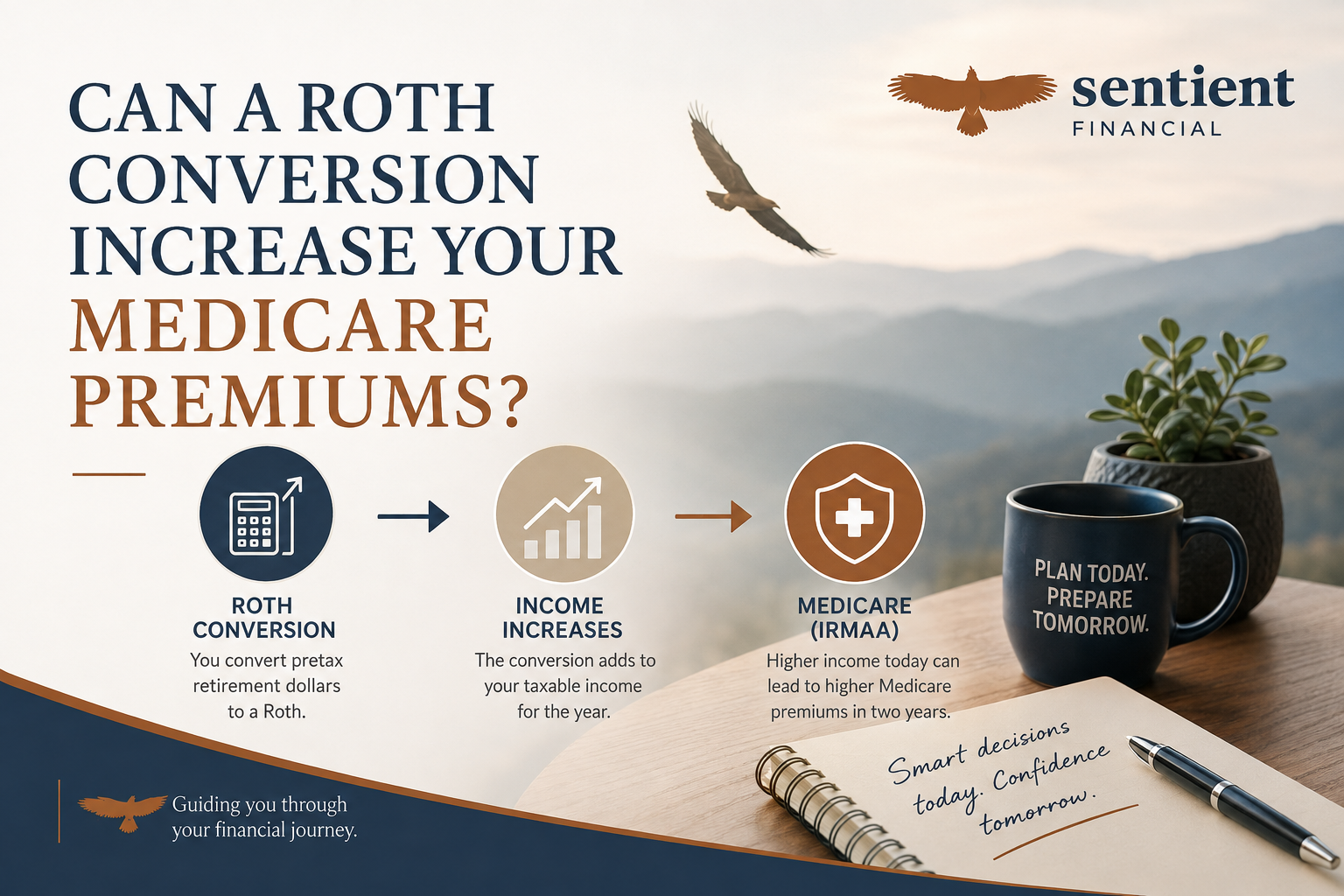
Yes. A Roth conversion can increase your Medicare premiums. But that doesn’t necessarily mean the conversion was a mistake.
This is one of those retirement-planning interactions that’s easy to miss.
You might complete a Roth conversion today as part of a long-term tax strategy. Nothing happens to your Medicare premiums immediately.
Then, potentially two years later, your Medicare premiums increase.
What happened?
The answer has to do with how Roth conversions affect your income and how Medicare determines your premiums.
Why a Roth Conversion Can Affect Medicare
When you convert money from a traditional IRA to a Roth IRA, the taxable portion of the conversion is generally included in your income for that year.
That additional income can also increase the modified adjusted gross income, or MAGI, used to determine whether you’re subject to Medicare’s Income-Related Monthly Adjustment Amount, better known as IRMAA.
IRMAA is an additional amount some higher-income Medicare beneficiaries pay for Medicare Part B and Part D.
So a sufficiently large Roth conversion can push your income into a higher IRMAA bracket and increase your Medicare costs.
If you want to understand how those income thresholds work, you can read my IRMAA Planning Guide .
Why the Medicare Increase Can Show Up Two Years Later
Here’s where things get confusing.
Medicare generally determines IRMAA using tax information from two years earlier.
For example, your 2028 Medicare premiums would generally be based on income reported on your 2026 federal tax return.
That means a Roth conversion completed in 2026 could potentially affect what you pay for Medicare in 2028.
This delay is why some retirees are surprised when their Medicare premiums suddenly increase.
They may not immediately connect the increase to a financial decision they made two years earlier.
A useful way to think about it:
A financial decision made today can potentially affect your Medicare premiums two years from now.
I go deeper into this timing issue in my article on the IRMAA two-year look-back rule .
Does That Mean You Should Avoid Roth Conversions?
Not necessarily.
This is where I think people can make a planning mistake by looking at IRMAA in isolation.
Imagine you’re considering a Roth conversion that would push your income above an IRMAA threshold.
You could decide:
“I don’t want to pay higher Medicare premiums, so I’ll stop the conversion at the IRMAA threshold.”
That might be appropriate.
But it also might not be.
A Roth conversion can potentially reduce the amount held in tax-deferred retirement accounts, which may reduce future required minimum distributions. It can also create a source of retirement assets that may provide additional tax flexibility later.
So the real question isn’t simply:
“Will this Roth conversion increase my Medicare premiums?”
A better question is:
“Does the potential long-term benefit of this Roth conversion justify the taxes and possible additional Medicare costs today?”
Those are very different questions.
That’s also why Roth conversions are generally better evaluated as part of a broader strategy rather than as a stand-alone tax decision. You can explore that further in my Roth conversion planning guide .
IRMAA Isn’t Necessarily a Stop Sign
I like to think about IRMAA thresholds as planning checkpoints rather than automatic stop signs.
Crossing an IRMAA threshold has a cost.
That cost should be calculated and considered.
But suppose paying additional Medicare premiums for a period of time allows you to complete a Roth conversion that potentially improves your long-term tax situation.
In that case, deliberately crossing an IRMAA threshold could still make sense.
In another household, the numbers might show that staying below the threshold is preferable.
The objective isn’t simply to minimize Medicare premiums.
It’s to make the best decision for the overall retirement plan.
The Years Around Retirement Can Create an Important Planning Window
This interaction can become particularly important during the years immediately before and after retirement.
Someone might retire at 62 with substantial savings in a traditional IRA or 401(k).
Their employment income suddenly disappears.
Social Security may not have started yet.
Required minimum distributions may still be years away.
That period can create an opportunity to evaluate Roth conversions while taxable income is temporarily lower.
But Medicare adds another consideration as age 65 approaches.
Because of IRMAA’s two-year look-back, financial decisions made before enrolling in Medicare can potentially affect Medicare premiums after enrollment.
That’s why Roth conversions, Social Security, Medicare, withdrawals and future RMDs shouldn’t necessarily be evaluated independently.
They interact.
That interaction is one of the central ideas behind retirement income planning . Your investments, taxes, Social Security, Medicare and withdrawals all affect the same retirement plan.
What About Withdrawals From the Roth Later?
There’s an important distinction between converting money into a Roth IRA and eventually taking qualified distributions out of the Roth IRA.
A taxable Roth conversion generally increases income in the year of the conversion.
Qualified Roth IRA distributions generally aren’t included in gross income.
That can make Roth assets useful later in retirement when you’re trying to manage taxable income alongside Medicare premiums, Social Security and other income sources.
Again, though, Roth conversions aren’t automatically the right answer. The appropriate strategy depends on your tax situation, retirement income needs, age, account balances and other circumstances.
The Bigger Retirement-Planning Question
IRMAA is a perfect example of why retirement decisions can become more complicated than they first appear.
A decision about a Roth conversion can affect:
- Your current income taxes
- Your Medicare premiums
- Future required minimum distributions
- Your future taxable income
- The taxation of Social Security
- The mix of taxable and tax-free assets available later in retirement
Optimizing one of those numbers doesn’t necessarily optimize the entire plan.
That’s why I prefer to evaluate Roth conversions as part of a broader retirement-income and tax strategy.
Sometimes paying a little more in one area today can potentially improve the overall picture.
Sometimes it doesn’t.
The important part is knowing the trade-off before making the decision.
Related Retirement Planning Resources
If you’re approaching retirement, these resources can help you connect some of the other decisions that may affect your plan.
IRMAA Planning Guide
Learn how Medicare income thresholds, the two-year look-back and retirement income decisions interact.
Should I Do a Roth IRA Conversion?
Explore some of the tax and retirement-planning considerations that can affect a Roth conversion decision.
Retirement Income Planning
See how taxes, withdrawals, Social Security and investments can work together in retirement.
Retirement Transition Series
Short videos covering some of the decisions that become important in the years immediately before retirement.
Retirement decisions rarely happen in isolation.
A Roth conversion can affect taxes, Medicare, future RMDs and the income available later in retirement. The goal is to understand those trade-offs before making the decision.
This article is for educational purposes only and is not intended as individualized investment, tax, Medicare or legal advice. Roth conversion strategies and Medicare costs depend on individual circumstances. Consider consulting the appropriate financial and tax professionals regarding your specific situation.
